Monday, March 7, 2011

Sunday visits to The Holy Grotto and St. Scholastica Monasteries

On Sunday, March 6, we visited the town of Subiaco, about 2 hours east of Rome in the Appenine Mountains, which run down the entire center of the Italian peninsula. The shrine of the Holy Grotto is the location of the cave in the mountainside which St. Benedict moved to in order to life the hermit's life. A monastery was eventually built around this grotto. The monastery has been built in stages. The 12th and 13th century frescoes are in magnificent condition. There has been little damage, (other than grafitti) from water, dampness, or wars or fires. The frescoes tell amazing stories of the life of Benedict and his twin sister, Scholastica; and the life of the Benedictine community and of the early church.

The entrance to the Monastery of the Santo Speco, (the Holy Grotto). The narrow gate was easily defended and permitted entrance by pedestrians and small animal-drawn carts. Today, small automobiles can enter.
The stairway leading the lower terraces of the monastery.
The Monastery of the Holy Grotto clinging to the side of the mountain. In the 1st Century AD, the emperor Nero had built a lavish villa at the entrance of this valley. He damned the river and dreated lakes for his recreation. The lakes are gone, but a large amount of the stone used to build the monastery was salvaged from the ruins of the Nero villa.
Another view of the monastery on the hillside.
Our group after Mass in the lower church. Priests from left to right. Fr. Richard Antall, Cleveland OH; Msgr. Anthony Sherman, Brooklyn NY; Your's truly; Fr. Luis van Than, New York NY; Fr. Anthony Nguyen, San Jose CA; Fr. John Clark, Owensboro KY; Fr. Daniel Carter, San Francisco CA; Msgr. Robert Lawrence, Harrisburg PA; Fr. Michael Oenbrink, Charleston SC; Fr. Frank Schuster, Jr., Bismark, ND; Fr. Steven Barber, S.J.
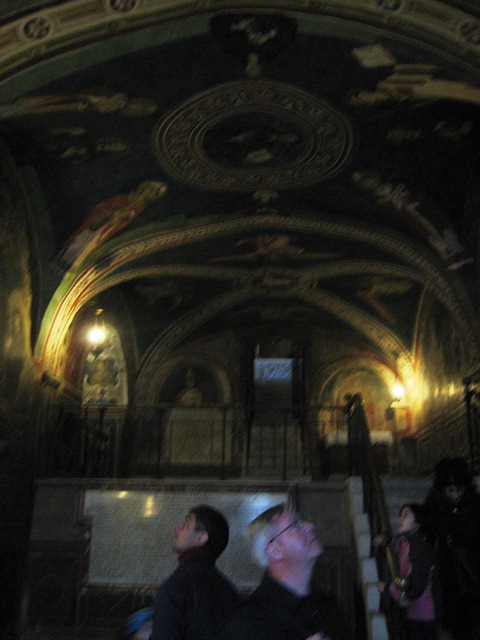
The lower church is a maze of passages built into the side of the mountain. Frescoes decorate the wall, ceilings, and even places where the rock cliff protrudes into the space, it was covered with plaster and frescoes painted on that surface as well. The view in this picture shows the multi level area. The central door above lead up a short stairway directly to the front of the main altar in the upper church.
The cave where St. Benedict lived for nearly 20 years spending his time in prayer contemplating the cross. He is depicted here as a young man. He was in his late 20's and 30's when he lived here. The basket, also carved in marble was how he was served his meals. A brother would lower his food to him by basket everyday.
A fresco depicting one of the miracles attributed to Benedict. The brother on the left known as the "goth" holds a broken tool. The metal part has fallen deep into the lake. Benedict takes the wooden pole and dips it into the lake and metal part is miraculously re-attached to the handle. The square light blue area with the fish depicts the lake.
St Benedict rescues a monk who has fallen into the lake.
A vault fresco of Christ the teacher.

A fresco of St. Francis when he visited the monastery. This fresco can be dated because Francis is protrayed before he receives the stigmata in the year 1224.
Death is a popular theme in the medeival frescoes. Death and the depiction of death in sacred art is not considered morbid in the middle ages. Death was seen as a glorious moment in one's life as eternal life was a possibility. In this depiction, death on horseback is shown as a skeleton weilding the sword and scythe. Horses were considered a great power in the middle ages. The soldier on horseback was a formidable, almost unbeatable oponent, therefore a symbol of the unbeatable power of death. Death is taking the life of a young nobleman holding a falcon, a sport of the rich. The dead under the horse are men and women dressed in the finest clothes. This is to depict that death does not care about age, gender, status or wealth. 
The maze of passages and stairs in the lower church are covered in some of the best preserved 12th and 13th century frescoes in Europe.
Fresco showin the nativity of Jesus
The main abbey church. Note how the top of the altar is below the level of the floor of the nave.
A mosaic greeting pilgrims into the cloister of the monastery. The mountains rising above the river with the cross are the center of the coat of arms os this monastery.
The cloister of the monastery with the cliffs rising above. There is no colonade as in most other cloisters because there was not the room to build one.


A view from the Monastery of the Holy Grotto looking below to the Monastery of St. Scholastica and the city of Subiaco in the distance.
The entrance into the Monastery of St. Scholastica with the campanile (bell tower)
The 11th century church was remodeled and dedicated in 1776 in the neo-classical syle. The frescoes which adorned the gothic vaults of the original church are still intact above the new ceiling.
The cloister of St. Scholastica is famous for its simplicity and elegance.
The columns are designed as symbols of Christ. The double columns are for the two natures of Christ, human and divine; the twisted single columns say that those two natures are unified into an inseparable truth.  
The elegant detail of the capitals.

The Benedictine order remains today as one of the most important religious communities in the world. There are several houses of Benedictine monks in New England; St. Anselm's College in NH, St Joseph's Abbey in Spencer, MA, and the Monks of Weston Priory in Weston VT. This was a great two days and the opportunity to see and experience some of the most important spiritual centers in the world.

This coming week is another fast-paced week of study and spiritual activities.

Monday morning, March 7 we begin a three day course on the theology and writing of St. Paul with Fr. Scott Brodeur, SJ. Monday evening, the priests and the institute are invited for cocktails and dinner as guests of the Paulist Fathers who staff the basilica of Santa Sabina in Rome.

Wednesday is Ash Wednesday. We begin with the celebration of Mass at the first of the 40 stational churches in Rome. There will be more about this each day as we participate in this devotion which goes back to the earliest days of Christian Rome when Christianity was decriminalized in the 5th Century.

Sunday, March 6, 2011

A Benedictine Weekend

Saturday and Sunday this weekend were filled with prayers, touring, and learning about St. Benedict and St. Scholastica. We visited Montecassino and Casemari on Saturday, and the Holy Grotto and St. Scholastica Abbey in Subiaco. I have many pictures. I am going to download them tonight, but I will return to write the captions for each one tomorrow.

Montecassino on the summit in the center. Not a very clear picture but its there. There has been a monastery here since 529 AD. It has been destroyed several times; in 577 by the invading Lombards, in 883 by the Saracens, in 1349 by an earthquake, and in WW II by Allied bombs. See the following photo.


An airial view of the Montecassino as it exists today. The monastery was completely rebuilt including the magnificent abbey church. This is a picture of the monastery reconstructed according to original plans after the destruction in 1944.


Montecassino Monastery after the February 15, 1944 bombing by the Allied forces in WW II. The Allies had false information that the Germans were ocupying the monastery. 200 Monks and civilians were taking shelter in the monsatery assuming they would be safe. They all lost their lives during the 3-hours of constant bombing. In this massive destruction, the only part that survived was the mortal remains of Sts. Benedict and Scholastica. There was a single unexploded bomb that was found embedded in the marble steps inches away away from the grave.


The Montecassino cloister. In the center is the opening for the cistern which is constructed under the cloister. The floor of the cloister slopes outward towards the pillars where there are drains to collect the rainwater. This was the only water supply for the abbey. The cistern is about 20 feet deep.
The facade of the abbey church
In the sacristy preparing for Mass.
The ceiling in the sacristy
The floor in the sacristy. There are over 60 colors and varieties of marble throughout the church.
One of the cabinets in the sacristy. There are 12 statues and panels like this one.
Signing the register before Mass. Every priest who celebrated Mass in this abbey for the past 600 years is recorded here. Its signed: Rev. Richard E. Degagne, St. John Neumann, Diocese of Fall River Mass.
Father Paul Martin of New Zealand presiding at our Mass in the crypt chapel. St. Benedict and his sister, St. Scholastica are buried here.
Our group after Mass.
All the ceilings are mosaics; all the walls are granite carved in relief, and the floors are marble parquet.
One of the side altars in the crypt.
The main altar of the upper church. The church was able to be restored because there were many photographs showing the interior and the details of the decorations. The church was reconsecrated by Pope Paul VI on October 24, 1964. At that time, he declared St. Benedict to the be the Primary Patron Saint of all of Europe.
The organ behind the main altar
The Blessed Sacrament Altar
The presiders chair. The abbot is also the bishop of the Diocese of Cassino
The pews in the choir
The burial place of Sts. Benedict and Scholastica.

A century later, a group of Benedictines who thought that the Montecassino community were no longer living in the spirit of Benedict, decided to split and form a separate community called the Cistercians. You may recall the posting of the visit to the Cistercian Monastere de Thoronet on February 26. The monastery at Casemari was the first Cistercian monastery to be formed. Here are the pictures of that abbey.

The abbey church of Casemari. Unlike Montecasino which has a baroque facade added later, this abbey preserves the medeival facade giving it a greater simplicity in keeping with the spirituality of the Cistercians.
The gothic interior of the abey church with its simplicity and lack of decoration. There is still a bit more detail than Thoronet which you can see on the February 26 posting.
Another angle of the nave. Note the windows. They are not glass. They are alabaster; a thinly sliced type of marble that is very translucent. There is a detailed photo following.
As alabaster window. The patterns are the natural patterns of the stone. These windows are nearly 1000 years old.
Another picture of the alabaster windows, this one taken without flash. It shows more clearly the beautiful patterns of the stone.
These choir pews are a later addition in the 17th century when baroque influences were added to the church. There is a baroque marble baldachino over the altar. The church was much too dark to get a clear picture. We were all agreed that it simply does not fit in the church. The only value in having a good picture of it would be to illustrate that at times a combination of styles just does not work.
The gate house of Casemari. The upper portion of the gate house was a 16th century addition. It was a residence of the administrator of the monastery. Sometimes, an administrator would be appointed to the abbey if the abbey territory had been lost to another government or noble family who won it in war. A cleric or even a lay person appointed to represent the interests of the nobleman or government lived apart from the monks but would be the ruler of the abbey.

Tomorrow we will visit the monasteries of the Holy Grotto and St. Scholastica.

Friday, March 4, 2011

Final Class with Fr. John Fuellenbach

This morning, we participated in the final class with Fr. John Fuellenbach, SVD.

Hebegan the session with a brief re-cap of his prior sessions speaking about the universal nature of salvation. Our religion is not a private religion; it is always pointing to the communion on earth and our communion in eternity. I am saved in order to bring the message, the good news, to the world. The theologian Karl Rahner believed that we must place in our center INCARNATIONAL theology. That is the mystery that separates us from other faiths and world views. No one has an understanding that God has entered into our human history end embraced the reality of the human person. Rahner wrote, "Because of the incarnation, God must look through the Son to see all creation."

Christ is the bearer of the Spirit to the whole world. Jesus is for everyone. Jesus came for all; christians, Jews, Muslims, Buddhists, Hindu, all philosophies. Fr. John stressed that the Vatican II taught that in all people of good will, the Spirit is there too. The Spirit is in all communities of people that attempt to live honorable, decent, and just lives. That is one of our great petitions on Good Friday. The Church is the means by which the Kingdom is preached, it is not identifiable with the Kingdom. Kingdom in meant for the whole world, universe. An individualistic view of salvation is not tenable.

The Church has a 3 part mission:
  • To proclaim in Word and Sacrament both the arrival and the presence of the Kingdom.
  • Must create communities in which the KIngdom is made manifest. We are a "test-case" for the Kingdom present in the world. In others words, as the church community, we must stand as witnesses of what it means that the kingdom is both present and coming. Church is both the reality of the Kingdom present and the anticipation of Christ's Kingdom to come. However, while we are in the world, that witness is always in a broken way. A spirit of reconciliation is part of the witness we give to the world. Christ is the "icon" of the Trinity and as God sees us through the eyes of Jesus Christ, so we see GOd through the eyes, and heart, and spirit of Jesus Christ.
  • Dialogue with the world in three ways: With Culture - with the reality of peoples lives where they are - cultures of nation, of life-style, of race, of gender, of language, of tradition, of generations, of politics, of economics,  of social status. All these are the ways in which the church must enter into dialogue with culture. Second: With the world at large - social justice. We have a message of joy for all people in the here and now, hearing all people yearning for freedom in the grace of God. And third - with other religious traditions. We must respect and find the spirit of awe in how God works through other religions and spiritualities. We can still say that we have the fullness of truth. Either Christ came for all or he came for no one. Every human being is gift from God.
Father John shared a story: When he visited the Catholic Cathedral in Samoa, he saw a painting that is on the wall of the cathedral. The picture shows a ship approaching the island with a bishop standing in the prow with mitre and crosier holding the book of the gospels. Behind him in the ship are Franciscan friars. Ahead of them, gathered on the beach are a community of people, with people of all ages, the old, the young, dogs, cats, sheep, goats, birds. They are cooking, fishing, building huts, caring for babies, and in their midst is a figure of Christ waving to the Bishop as if to say, "It's about time you got here." The artist wants to say that even before the missionaries arrived, Christ was in their midst because they are a good people. Its a message of warning to religious people not to assume that the spirit is not present because they may have not heard the gospel.

Reflections on the Lord's Prayer

In this prayer is the summary of the whole of salvation and Kingdom message. All the big themes of Jesus' mission given to the disciples are found here.

Here is another tib-bit for the catechumens and candidates to be recievd on Holy Saturday.
(And its not a bad thing for the rest of us to know either.)
In the early church, the Lord's Prayer was reserved to just days before the reception of the Easter Sacraments. The Lord's Prayer would be taught to the "elect" only days before they would be baptized. This was a prayer that was not spoken outside of the church. It was secret. (Remember, this could be because the gospels were not written immediately, and even after they were written, they were not widely diseminated. The gospel was still transmitted by word of mouth to a culture where reading was rare.) It was only the baptized who could call God "Abba". This practice is still found as a part of the R.C.I.A. with the presentation of the Lord's Prayer in these final days of preparation for our catechumens.

In the ancient times, spiritual leaders would offer a prayer that would summarize the teacher's ideas and vision. This is why the disciples of Jesus asked to teach them to pray as John the Baptist had taught his disciples to pray. And so in the Lord's Prayer, all the ideas are found somewhere in the Old Testament, especially Matthew's version - who's gospel presents Jesus as the fulfillment of the Covenant. Jesus is the fulfillment of the God's covenant with his people and is the final revelation of God's truth to us. And so, if we pray seriously the Lord's Prayer, we are declaring, by the very act of reciting the prayer, WE ARE DISCIPLES OF JESUS CHRIST.

Parts of the prayer:

1. Address: Our Father
Who is God for you? When you call God, Father, what are you saying to God? what are you saying about yourself? What are you saying to the world?
When the Jews began to pray, they would recite the "shema" Deuteronomy 6:4 - Hear, O Israel, the Lord our God is One. This was how the Jews remind themselves of their relationship with their God. For Christians, our "shema" is not about what God did for  us; it is rather who God is for us. And so if we claim God as father, "abba", and God is father, "abba" for ALL, then we are all brothers and sisters. If we sincerely mean what we pray when we say "Our Father", then all discrimination must be condemned forever.

2.  Thou petitions:

Name: Your name is holy and make it known:
   To me
   To all human beings
   Until the day comes when everyone knows your name.

Thy kingdom come: The new world is already in the old. God's saving work began at the first moment of creation.

Thy will be done: This is the Matthew addition. For the Jews it meant let that which reigns in heaven come to earth. We Christians believe that this has happened in Jesus Christ. NOtice in scripture that whenever Jesus must confront the will of his Father, he is distress. When Jesus is in the sight of the cross at Gethsemene, he asks, "Take this cross from me, but not my will but your's be done." Christian tradition does not go looking for martyrs. We have not been taught to commit suicide for Christ. It is more important for saints to remain on earth to fulfill the mission of Christ. But if one is caught in a situation, and is not given a choice, then martyrdom is is the crown of heaven. Jesus does not say if they don't accept the message, blow them up. He says shake the dust off your feet and move on to the next town.

3. We petitions:

Give us today our daily bread.

Fr. John says this is not about give me a sandwich. It is one of the great themes in Jesus' ministry. St. Jerome, in his early commentary of the Scripture read bread as "Mahar", in Hebrew it means the bread of tomorrow. In other words, the glory yet to be revealed. Give us this future bread today so we may live in your glory now. But bread is also important as the opportunity to share table fellowship together. This is a prefiguring of Eucharist, and a prefiguring of the eternal banquet of heaven. In Scripture, bread fills physical hunger and social hunger. Dining together is not a profane thing , but binding community together. And it is important to note that is says, "give us", not "give me".

Forgive us our trespasses...

It is said sometimes, (and I will take 3 mea culpas for this one) we are asking God to forgive us in the same we are forgiving others. Fr. John says this is wrong. Three times he said it for emphasis. We must never forget that God's initiative is always first in the scripture. It is not because I forgive that God must then forgive me. Rather, Because God has fogiven me, (God's action is prior) than I find it within myself to forgive. (My action is the consequence).

Fr. John's personal experience of someone who comes up to him to say, "Father, I can't forgive." His reply is, "Who do you think you are? God?" Only God can forgive absolutely and unconditionally. The world has to work at it. But why would we want to forgive? It's like when someone was generous to me, I feel the urge to be generous in return. If not, I am ingrate. I can forgive because I have experienced the forgiveness of God first.  And if I am unable to forgive it is because I have not yet become aware of God's forgiveness in my life.
God cannot forgive if I am unwilling to forgive. If I refuse to forgive, then God cannot forgive because God will not impose himself upon us.

Temptation: The great temptation of the early church was apostasy, the formal denial and recanting of the faith. This is not really a catch-all for every sin in my life.

Well there you have it. All the notes of this week. I need to review these later and fill them out. That will happen in my future preaching and teaching. Stay tuned.


Speaking of tune - There are posters of a piano recital at the Church of St. Agnes in Ecstasy in the Piazza Navona tonight at 6:30. I have just enough time right now to dress up for a recital, walk the 30 minutes and listen to Mozart, Chopin, and Geshwin. I was out this afternoon to get a haircut and I stepped into the Church for the Germans in Rome. Santa Maria de Anima. Its a beautiful baroque church near Piazza Navonn. There are two chapels important to me:  one with a beautiful painting with the Holy Family and St. Anne. I have never seen that image before The proud grandmother looking on. I will be looking for a print of that somewhere. And second, a chapel to St. John Nepomuk. Why is he important? John Neumann was named after him. Our patron's name is actually John Nepomuk Neumann.

Not sure what time I'm coming in tonight. This may be it for the day.

Ciao a tutti.

Thursday, March 3, 2011

Tough Question and a Fun Decision

Tonight, I am attending the first in a series of classes to learn Italian. I have said for years that I want to learn Italian. I figured that 3 months in Italy would be a waste if I did not take advantage of this while I am here. There will be more about this soon, I suspect.

So back the tough question.

What happens at the moment you die?

The question is part of Fr. John Fuellenbach's discussion about the kingdom of God and the "God-Image" that we need to develop in our reflections on the Gospels.

Most concepts of heaven and hell are based on the the Old Testament vision of the wrathful, vengeful, punishing God. Or they are based on the "repent so you can receive the kingdom" message of John the Baptist. Or they are based on the legalistic "follow the rules and regulations of the church" teaching that we have all been subjected to for centuries.

We must start to rethink our relationship with God, rethink the kingdom language, so that we come to experience God's love for ME. Fr. John never says, for US, always for ME. God's immense love is a personal love for every individual person who was, who is, and who will be. Individual persons responding to this immense, unconditional love of God are the church in the world.

There are only three things that bring us into the presence of God: Thanksgiving, Adoration, and Praise.

When I die:
  • All pretense falls away. I come to the absolute knowledge of who I am and that I am infinitely loved. I am filled with all the awe of the eternal, merciful, compassionate God.
  • I will see and come to understand that it was God's love which gave me life, which bore me every moment of my life, which invited me to be faithful. The question that I must now consider standing face to face with this infinite, unconditional love is "How did I respond to this infinite, unconditional love?"
  • I will stand before this infinitely compassionate God and I will know that I had at every moment of my life, the possibility of ultimate joy. What did I do with this?
  • And so, ultimately, it is not God who judges. Now that I have this infinite knowledge, it is I who judge myself. God does not judge.
  • When Peter denies Jesus three times, he already has the knowledge of Jesus' love and Jesus warns Peter that this denial will take place. Peter is adamant that he will never do this. At the cock crow, Jesus simply turns to look at Peter and does not need to say a word. Peter knows in his heart what he has done, Peter judges himself. And he goes out and weeps bitterly, the scripture says.
  • However, the effects of my sin remain. I still have in my heart the knowledge that I have sinned and rejected this ultimate and infinite love. The time that is needed to purge that knowledge before I fully accept myself as uncondintionally loved by God is what the church calls purgatory.
Fr. John ended with a statement that kind of blew us all away.
God's love triumphs over justice.
Justice, which requires judgment decisions on the part of God is not how God ultimately wants to deal with us. God wants to delight in his people. God wants to love us unconditionally. God, through Jesus offers us the example of defenseless love as a sign of divine providence.
God's love triumphs over justice.
It is not about peace imposed by anyone, but rather an unconditional love which allows one to accept another as he or she is. This is how God loves. This is how we are called to love.

Powerful day! This will require a great deal of meditation and contemplation: con = with; templum = temple. From the temple - to think as God thinks. To know as God knows. To love as God loves. To attempt to understand the world from God's point of view, from His mind and heart. That is the mark of holiness. That is the mark of sainthood.

Tomorrow morning is the last sessison with Fr. John Fuellenbach. I bought a second book of his entitled, "Proclaiming the Kingdom" It is a collection of stories and anecdotes he has collected over the years. In this book, he connects them to the scripture passages of the lectionary. It will be a very helpful little volume I think. After class and Mass in the morning, the afternoon and evening is free. I will have to look over lists of destinations in the city of Rome for the afternoon and evening.

On to lighter things.

I went to my first Italian language school class tonight. I have decided to commit three evenings a week to the study of Italian. By the time I leave, I will have attended 18 classes.  I am attending the Dante Allighieri School of languages. Francesca, a young woman in her early 20s is our teacher. The other students are Fr. Joe Porpiglia, who is here with me at the Institute; Roy, a young Israeli with a Spanish wife living in Italy; Beata, a young English-speaking woman living here in Rome; Manuel, a recent college graduate from Argentina who is spending three months in Italy as a graduation gift from his parents; and Los, a Nigerian man who works for his Embassy in Italy. I am actually beginning two weeks into the class, but I did surprisingly well relying on my fluency in French and a basic knowledge of Latin. These classes will be held on Mondays (Everything else in Italy is closed on Mondays), Tuesdays, and Thursdays. That means that Fr. Joe and I will have to miss supper (cena) at the seminary. (Actually supper meals here may be the worse meals available in Rome). We will just have to suffer the burdensome decision about which Trattoria, or Pizzeria, or Ristorante to stop in after class - to practice Italian of course.


Buona notte a tutti.

Wednesday, March 2, 2011

Rainy Day 2 - Special Blog for our Catechumens

Woke up to another rainy day. The bright side of that is that the Italians on the NAC staff say that the week before spring arrives is always rainy. Looking out my window confirms it. There is a huge magnolia tree with the bright flower buds ready to bloom. Also a long row of dogwoods with the buds ready to pop open. So I will put up with a few days of rain for that - not to mention that we have a week of classes right through to Friday morning. Let it rain until the weekend.

Friday after pranzo is free until Monday morning. I am participating in two bus trips; one on Saturday to the Abbeys of Montecassino and Casamari, and on Sunday to Subiaco. I guess there will many more pictures on Monday.

In the meantime, Fr. Fuellenbach's presentation continues to open up new ideas and insights into faith and spirituality. Also, tonight I have homework. He gave us 9 single-spaced pages to read and reflect on for tomorrow's classes. That means my blog will be a bit shorter tonight. I will travel home with the notes - you will get them sometime in the future, be assured.

Notes for Wednesday, March 2, 2011
Fr. John Fuellenbach, SVD

Father John began with an image that gave me chills:

THE GOSPELS ARE WRITTEN IN THE LIGHT OF THE EASTER CANDLE.

Are you reading this catchumens? And the rest of the parish too?

THE GOSPELS ARE WRITTEN IN THE LIGHT OF THE EASTER CANDLE.

I have to admit that I missed a few of Fr. John's statements after this because of the important images that this line teaches.

For me, the most powerful moment in the life of our worship is that time when the power of the Spirit descends on the church - the baptized and on those about to be baptized - on Holy Saturday Night. We are all standing in the church after the mob has stood around the fire and has processed into the church chanting, "Christ, Our Light", "Thanks be to God". The Easter proclamation is sung and the community's faith is consecrated in the natural light of the Easter Candle and the flame which has been shared by all who seek the Spirit. It is this worshipping church which prayed together and celebrated together the resurrection of the Christ. This experience of Faith and Worship, two to four generations later, was preserved in the Gospels. The Gospels, therefore are the story of the early Christian community's witness to the Risen Christ, which we celebrate at Easter and at every gathering of the community for Eucharist.
The light of the Easter Candle enlightens us;
The light of the Easter Candle inspires us to live the message of Christ,
The light of the Easter Candle is our guide to opening up the kingdom in our time.
The light of the Easter Candle is the light on the way to the kingdom forever.

Tonight I'm thinking of the Canditates and sponsors and catechists who are working together to approach the saving waters of Baptism and make their profession of faith as disciples of the Lord Jesus Christ. I am already anticipating the thoughts of my absence on that special night for you and for our community at St. John Neumann. I'll be concelebrating the Easter Vigil with Pope Benedict, but I think my heart will be with you.

OK - back to Fr. Fuellenbach

What is Jesus about?
  • Man of the Spirit
  • Social Prophet
  • Teacher of alternative wisdom
  • Movement founder - Table Fellowship
Jesus is the Man of the Spirit: Everything in Jesus life and ministry, death and resurrection is all about sending and instilling in us the Holy Spirit. He is the channel of transcendence.
  • Jesus the man is a creation of the Spirit
  • Jesus becomes bearer of the Spirit
  • Jesus is the giver, the dispenser of the Spirit

The Spirit is upon us from the first moment of creation. In Genesis, God breathes the life Spirit into the nostrils of Adam.
  • At the Annunciation: Mary is not the point of this story. Mary's willingness to receive in her body the fruits of the Holy Spirit and her acceptance of the Spirit which will come upon her is what this story is really about. Christ is conceived by divine power of the Holy Spirit.
  • In the meantime, the Spirit is present in the parents of John the Baptist who is conceived in his parent's old age. In the Scripture this is always a sign that God bestows his spirit on his people in order to accomplish something wonderful.
  • John the Baptist's ministry speaks of his baptism of water, but the Messiah will Baptize with fire.
  • Jesus is baptized by John but it is God who sends the Holy Spirit on him and will remain with him until the end. Everything that Jesus does is in the Spirit. The fullness of the Spirit remains with him permanently. In the Old Testament, the prophets speak through the power of the Spirit but the spirit does not remain with them.
  • After Jesus' baptism, he retreats to the desert where the Spirit is tested. All the realities of the world which stand as opposite of the unconditional love of God and the defenseless love which he will teach is laid before Jesus: power, wealth, omniscience. Jesus rejects them all.
  • He now goes back to the place where he was born as the beginning of the ministry. Luke 4:16-21. He goes to the synagogue where he was reared and takes up the passage of Isaiah and proclaims, "The Spirit of the Lord is upon me, therefore he has anointed me. He sent me to bring glad tidings to the poor, to proclaim liberty to captives. Recovery of sight to the blind and release to the prisoners. To announce a year of favor from the Lord." We need to understand what he is doing. From his first teaching, Jesus is reminding them what their own tradition says. He is including all the people that the community has rejected: the poor, captives, sinners, (the blind had to have sinned to incur the wrath of God in this way.), criminals, and redemption. (A year of favor was a festival that would take place once each generation where all debts were forgiven. You had a new start.) Then he tells them that this passage is now fulfilled. The people like what they hear. "Is this not Joseph's son?" In other words, this is the homeboy who's done good. This is maybe not the response that Jesus wants to elicit from this crowd. Jesus probably thought they would be upset by saying that the ancient scripture was now fulfilled, so he must take it to the next level. He now hits them in the face with the times that the spirit was rejected by them, the times when they rejected God, and so God bestowed his mercy on gentiles. This enrages them. Jesus sets the stage for the release of the spirit on the world - His death on the Cross.
  • Jesus' mission is to release the Spirit on the World. At the moment of Jesus' death on the cross, the gospels report; Matthew 27: 50. "Jesus cried out in a loud voice, and then gave up his spirit. Luke 24:46. "Jesus uttered a loud cry and said, 'Father, into your hands I commend my spirit. John 19:30b. "Then he bowed his head, and delivered over his spirit."
  • Pentecost: Jesus bestows the spirit on the disciples and makes them alter christus, other Christs. He reminds them of what he had said earlier. Fr. John says the better translation would be, "I came into the world to throw fire. (Hence the title of one of his books, Throw Fire.
From the moment of Jesus' conception, when Mary says yes to the power of the Holy Spirit upon her, the spirit is in Jesus, works through him, and is given to us by him. THE ENTIRE PURPOSE OF JESUS' LIFE, DEATH, RESURRECTION, AND ASCENSION IS TO RELEASE THE SPIRIT UPON THE WORLD ONCE AND FOR ALL!!!

After the trial and crucifixion of Jesus, the disciples were hiding because they were afraid. The law was that when an insurrectionist was convicted and executed, his "disciples" were hunted down and put to death as well by their association with him. I never knew this bit of history. Doesn't it make sense that the disciples were afraid and hiding? But Jesus who now appears to them, talks to them, even eats with them, releases the Holy Spirit upon them.

John's gospel is especially beautiful: Jesus comes to them and says, "Peace be with you. "
Fr. John says that the translators should have not translated the Hebrew word, "Shalom", in the gospels; it should have been left the way Jesus spoke, like the hebrew words are not translagted elsewhere in the crucifixion story. "Shalom" is much richer in meaning than simply peace, which can mean just an absence of conflict or struggle. "Shalom" also means I have an acceptance of you. It means that Jesus is not condemning the disciples but continues to love them as they are; filled with fear, confusion, and doubt.

Then Jesus breathed  on them, "Receive the Holy Spirit". They would have known that the gesture of breath was the same gesture that gave life to Adam in the Genesis story. The second Adam now gives them new life. The apostles have now become new creations in the Holy Spirit.

John's gospel continues with the gentle acceptance of Thomas' doubt, the mention of many other signs not recorded here, and the brief return of the apostles to their former way of life - fishing. In a kind of "this is the last straw", push-over-the-edge gesture, Jesus allows them to catch a huge amount of fish. It becomes for them the sign of the new life upon which they are about to embark.

And finally, the dialogue with Peter. Three times Jesus asks him, "Simon, son of John do you love me?
Three times Peter says, "Yes Lord, you know that I love you." Three times Jesus says, "Tend my sheep." "3" is the divine number in the scriptures and symbol of perfection as God is perfect. 3 as in the Trinity is the perfection of the relationship of love which is God. 3 is the number of times that Peter denied Jesus - perfectly. Now Peter is the one called to devote his life to the perfect love of the heavenly Father who:
  • loves unconditionally
  • forgives unconditionally
  • present unconditionally with compassion
As church we are called to live in the spirit. Paul says, when God recognizes the spirit in you, He will call you his child.


Jesus in the Social Prophet:
At the time of Jesus, the convenant relationship with God was irretrievably broken. Covenat had come to mean an unbending and strict justice. There was no equality.

Christian anthropologists speak of what it means to be human in light of our creation by God:
We are Body and Spirit; and we must enter into right relationship with God, with myself, with others, and some include these days, with nature. We know we are in right relationship when they are "life-giving" and not "life-taking"

And so in Jesus' time, there arose a series of "kingdom movements" which included:
  • Exclusivity - Pharisees and Saducees
  • Violence - Zealots
  • Judgments - St. John the Baptist - repent, (although he realized who the messiah was)
Jesus comes along and proclaims a kingdom for all those who are excluded by the others; poor, women, children, sinners, and the physically handicapped who were belived to be sinners by their infirmities.
Jesus wants to restore the right covenant with God.

Jesus asks is Matthew 12:42ff, "Who is my mother?" Jesus not showing disrespect to his mother, but he is putting aside clanishness.
When Jesus is told, "Happy the woman who bore you, and the breats that nursed you." Jesus replies, "Happy those who know the will of God and put it into practice." (paraphrase) Jesus is actually praising his mother here because he knows what she has done by following the will of God.

Galatians 3:27-28. St. Paul understands what Jesus is attempting to do. And so he can write that all barriers of social classes, race, gender have no place in the kingdom. Through Baptism, we share in the right relationship (read covenant) with God from the first covenant, but especially the new covenant of Christ and the Spirit. In parables like the Good Samaritan, Jesus breaks down the restrictions placed upon people by the law, convention, attitude, and customs. Jesus gives this parable to illustrate what the inquirer should have known already.
In an aside, Fr. John said: "Jesus never gives an answer when you can answer yourself"

For Jesus, justice is not "getting what I deserve", rather imitating the unconditional love of God.

Jesus the Wisdom Teacher: The Bible has a huge body of "wisdom" writing which includes poetry, prose stories, short one-line sayings, and parables. For some scripture scholars, the entire message of Jesus and God are ultimately found in the parables. There are 36, and possibly 42 if the one sentence "the kingdom of God is like..." in Matthew are included. Parables are offered because they are where we learn a God Image.

Jesus breaks all the molds of convention, and even common sense. People who would have heard the parable of the lost sheep would have thought Jesus was out of his mind. Luke 15 is addressed to the scribes and pharisees. When you think of it - why would a shepherd risk 99 sheep to find one who will probably be only a carcass when he gets there. It was economically stupid to risk the whole flock for one who was probably destroyed by wolves or lions anyway. The God Image is the God who loves each individually for his own sake. The parable is told for its shock value.(Remind me someday to tell you about the story of the papal nuncio who wanted to do a confirmation in Australia to a community of sheep herders) Hey people. I'm going to tell you something so absurd that now, maybe I will jolt you and you'll pay attention to the next thing I'm going to tell you. Then we hear the story of the woman who finds the lost coin. The God Image is a God of JOY. The scribes and pharisees could have cared less about the some woman who couldn't keep track of her possessions and probably would not have related to a joyful God. But now comes the big guns: the Parable of the Prodigal Son.

What is the God image here? The unconditional lover, the unconditional forgiver, the unconditional presence of compassion.

Jesus is breaking the mold of the social order and changes everything. He never offers what society looks for.

The world looks for success and demands competition;
Jesus looks for faithfulness and demands compassion.

Jesus preaches an Alternative Wisdom - a relationship with God that is totally new from the Old Testament: The wrathful punishing, vengeful God.
Jesus is the incarnation of a merciful and generous God.

In this new Covenant, the wisdom is to be in right relationship with God.
  • God loves unconditionally: This does not depend on me or on anything I do.
  • I am unconditionally loved: The only security in a Christian's life is knowing God's love for me.
  • My neighbor is unconditionally loved.
Christ's love for us is a defenseless love.

Well so much for the short posting. I am going to quit for now and take this up tomorrow.
The next area of discussion is a small question    (yeah, right!!!)

What happens at the moment you die?

 I have some reading homework to do. So I am going to take this up tomorrow. I'm fearing that the material we hear tomorrow will put me terribly behind. I may be only to do some of it. You may all have to wait until I get back and let's talk about this over pasta and refreshment in the hall.

Buona notte a tutti.


Tuesday, March 1, 2011

Two Classes and a Rainy Ray - Perfect!

It's mid afternoon right now and I'm back in my room after Mass and lunch. We had a first session with Fr. John Fuellenbach, SVD today. He is a spiritual director and theologian. We had a two-hour session with him this morning and another 2 hours coming up this afternoon. I have about 6 pages of notes from his talk this morning. I was a bit distracted at Mass trying to figure out how I would present this on the blog. His clever images and diagrams which he drew on the board are a big help to understanding his teaching. But he also has many great short definitions and one-liners that are very revealing. I think I will proceed by just offering some of these and give you the opportunity to just reflect on these yourself. I have a sneaking suspicion that you may hear these ideas live when I get back in homilies and talks. I already decided to purchase his books and get a more thorough exposition of his ideas even though we have him for another 10 hours for the next 3 days. Perfect for a rainy week prediction.

I was joking with Fr. Paul Martin from New Zealand about the blog. My people at home may be confused that I will blog about spiritual things this week, and not just about art work and pasta.

I will start to offer some reflections on this morning's session which was entitled: Following the Lord / Discipleship. I will put bullet points beside my notes. These will have to be filled out later. Use them for some of your own reflection.

Father John Fuellenbach, svd.

The first sense I got from Fr. John is that he truly loves priests and the priesthood. He started his life as a horticulturalist. He thought he would devote his life to flowers. But God called him. Now he devotes his life to the "flowering of faith" as he put it.

  • Theology must be: 
                              1. Scientific
                              2. Pastoral
                              3. Spiritual
  • Theology must be balanced in real life between human freedom and the Holy Spirit.                       
He said to us, "Go home with a new joy. There is more than administration; there is 'kingdom'".
He spoke of the Prophet Ezekiel who reflects on his own calling by God.
  • God raised me up.
  • I can hear what God has to say.
  • I can understand what God has to say.
Fr. John spoke of being focused on the kingdom. He used an image of a theatrical spotlight. There is a strong central beam which lights up the center, but there is some peripheral light around the sides. For the Christian disciple, the focus must be Trinity - more than simply that God loves, rather God IS love. In the periphery, we have Mary, the saints, the sacraments, and devotions, rosary, pilgrimages, and many other practices. These are important in the periphery because help us and lead us to return to focus on the central beam which is the One, Triune God.

We get it wrong sometimes. We get out of focus and we can get used to it to the point that we can lose the truth. Fr. John told this funny little story.

He enjoyed hanging wallpaper. He heard from his sister in Germany that she had put up a room of wall paper. Sometime later when he was visiting and saw his sister's work, he had to tell her that she put up the paper upside down. His sister commented that she thought something was wrong, wasn't quite sure what it was, but she had gotten used to it. He said that she had come to accept and had become used to the mistake.

The goal of discipleship is JOY.
  • The result of union with God who is LOVE is JOY.
  • The word JOY is used 352 times in the Bible. 
  • The idea, "Do not be afraid" is used 366 times
  • In the Gospel of John, the opposite of love is fear.  

WHAT WAS JESUS ABOUT? Christ came for two things.
  • For us to have a God experience: The word "Abba" occurs in the New Testament 254 Times. It never appears in the Old Testament which rather speaks of God's "womb-like" love. In Luke 12:49, Jesus says he has come to bring fire. This translated from the Greek "dynamis", (from which coincidentally we get the English word "Dynamite". To be on fire in the mind of the New Testament is to be action oriented, cause change. Doesn't dynamite cause radical change? This God experience also helps us to understand the three fundamental aspects of God.
                      God loves ME unconditionally
                      God forgives ME unconditionally                             
                      God is always with ME - compassion.
                           (from the Latin com = with, and Passio = passage)

           Pope Benedict XVI first encyclical: He says that God does not love, God is love.
                      God is not in our "brain bank", not just stored up in intellect.
                      God is in the heart

           This next section is AMAZING:
                      God looks at us with DELIGHT.
                      Ultimately, we must face God's love.
                      The last judgement is not that we must face God's WRATH;
                             It is that we must face God's LOVE,
                             and maybe know that we have rejected PERFECT LOVE
                             time and time again.
                      You can develop a theology that makes hell as hot as you want;
                             it doesn't matter.
                     As human beings we tend to ingnore and reject negative consequences.
                     We've all heard people say, "There is no hell, Hell is on earth."
                     But when we come to realize as we stand before the perfect love of God,
                             that we have ingnored and rejected perfect love?
                                       That's scary.

  • To know the Kingdom of God: Jesus came to bring the kingdom or the reign of God. The phrase "kingdom of God occurs 162 in the New Testament, 92 times on the lips of Jesus.
               Vatican Council I never uses it.
               Vatican Council II uses the kingdom of God 75 times.
                     The vision of Vatican II is that the Church is in the service of the kingdom.
                     The church is not identical with the kingdom.


What is God's Dream for all creation:
  • To be infused with the Holy Spirit.
  • There is a dynamism:
                 Giving
                 Receiving
                 fullness of life.
  • God comes down - we are not pulled up. This is incarnational theology. God pitches his tent among us. He fills us with the spirit - life, love, joy, radiates out to all to be transformed in the image of Him. John 17:22-26. This is not for a few but for all.
  • Our task therefore is to preach the right image of God.
  • The mission of the Church is dialogue and Christ is the only mediator of all this.
There are two things our culture values which is NOT found in Scripture:
  • SUCCESS: The task of the disciple, whether ordained or lay, is not success. It is Faithfulness. Faithfulness to the Christ and his message. My role is not success in programs, or administration, or large numbers. In the eyes of the world and even in the eyes of the apostles until they received the Spirit, Jesus was a complete and utter failure. But he was faithful to the Good News and to the will of the Father.
                What saved the world is defenseless love, not power.
                The early Christians never talked about the cross. It was too painfull.

  • Optimism is not talked about in the Bible. Rather, Compassionate love in spite of failure - Christ is risen. Col. 1:27.
  • Richard Rohr. "Suffering means you are not in control anymore."
  • When Peter cuts off the ear of the high priests servant, Jesus heals him. The message to Peter is, "This is not the way to save the world." What is needed is a defenseless love.
  • The disciples did not get this. In Mark, at the death of Jesus, they run, and lock the door and were afraid. Fear is the oposite of love. They were not ready for defenseless love until they are filled with the Spirit.
What did Jesus ask of those who listened to His message.
         "Follow Me"      20 times.
                                 4 times in Mark
                                 6 times in Matthew
                                 5 times in Luke
                                 5 times in John
      This is the fundamental norm of Vatican II: Follow the Lord as He walked.

What did Jesus do for 30 years before his public ministry began. HE lived as a human being. Mary and Joseph taught Jesus how to be human.

As Jesus lived in fellowship with others, so we are called to live in fellowship.
What is Fellowship in Christ?
  • It is identity giving. By imitating Christ, we gain our identity as disciples.
  • Defines the church as community of disciples.
  • Only by following Jesus, can we ever hope to know who he is.
Session 2, 4 - 6PM

How are we as Christian Disciples different from other religions and faiths. (Problem with too many people who have this notion that all religions are the same.)

  • Buddhism, Hnduism, and Confucianism: Not religions at all, but philosophies and world views.
  • Judaism is a Book Religion
  • Islam is a Book Religion.
  • Christianity is not a Book Religion: it is a personal experience of another person. The center is not an academic, a teacher, a spiritual guide, but a personal commitment to another person, Jesus Christ.
  • For Jews, "Torah" means "Way of Life"
  • Jesus says to us, "I am the way of Life,"
  • Christianity is fundamentally not a set of laws, it is a living faith. The "book", the New Testament comes out of the lived experience of faith, not the other way round.
  • Christianity is not just dogmatic. It is not a system of morality. It is not ascetical or discipline. It is mystical - a personal relationship with a living person.
Fr. John asked us, "Do you know the first and last words of Jesus in the Gospels?"
     I have to admit that I did not know. I know now. Do you?

In John: "What are you looking for"?
      Jesus asks that question other times in the Gospel. He responds to the person with the answers,
  • Come and see.
  • Come and stay with me
  • Remain with me
  • Abide with me.
Fr. John told us of a story of a conference in comparitive religions that he participated in. Around a circle were, Jews, Muslims, Budhists, Hindus, and Catholics. The facilitator put a poster on the ground with the word GOD on it. The Muslim immediately stood up and picked up the poster and said this was an insult to God. God is not on the ground. Fr. John told us that it was a perfect lesson in incarnational theology. "God is in your midst" For us as Catholic Christians, there is not problem believing that God is present to us, God is in the world, God is descended to share our humanity. That is the primary difference between Christianity and the rest of the world. And we as Catholics believe even more deeply than many other Christians because we belive that God is truly present in our Sacraments, in our Eucharist, in our pristhood, and in our church. Not in just a symbolic presence, but a real presence to which we can be committed. We can truly share in the love, life, and joy that God is.